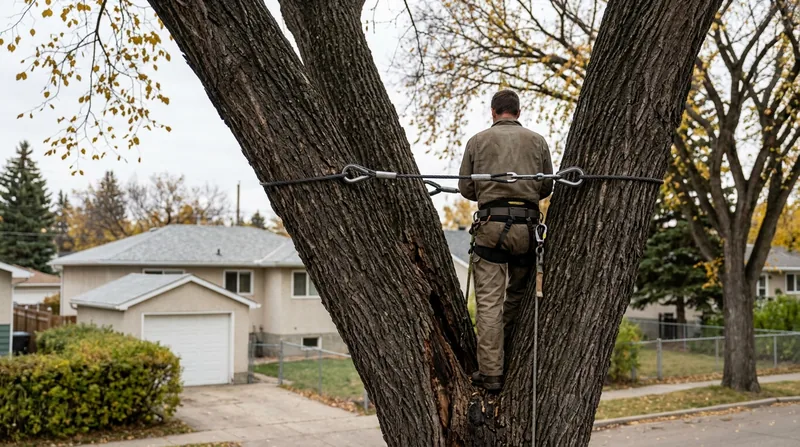




Tree cabling and bracing in Regina protects mature trees with structural weakness before they fail. Older Manitoba maples, elms and oaks across the Regina area often develop weak branch unions or codominant stems that split under ice load or summer wind. Our ISA Certified Arborists install dynamic cable systems to support these trees, keeping them safe and preserving their canopy. We have served Regina since 2016, combining hands-on inspection with proven bracing techniques tailored to in Regina and the surrounding area's freeze-thaw cycles and storm seasons.
Why structural support matters for mature trees in Regina
Trees with splitting stems or weak crotches do not self-correct. Ice storms and wind gusts put enormous stress on these unions, and failure happens fast. A limb that breaks mid-storm can strike a house, fence or power line. Cabling stops that risk by restraining movement and distributing load across the tree's strongest points. We inspect every candidate tree to confirm cabling will work before we install a single cable.
- We assess the tree's overall health and structural soundness.
- We identify weak unions and codominant leads that pose the greatest risk.
- We select cable gauge and anchor points based on the tree's species and load.
- We install cables at the proper height and angle to reduce branch movement without strangling growth.
- We schedule follow-up inspections to monitor cable tension and tree response.
Cabling is not a permanent fix, but it buys a tree 10 to 20 years of stable structure, especially valuable for heritage trees or specimens with sentimental value.
Local insight: Regina's post-war subdivisions contain many mature maples and elms planted in the 1950s and 1960s. These trees now carry heavy crowns and often split at the crotch during spring ice storms or summer straight-line winds. Cabling has prevented hundreds of removals across the city.
How we install cables and braces in the Regina area
Our process starts with a detailed climbing inspection. We examine the tree from ground and crown, photograph the weak points, and measure the branch angles and diameters. We then recommend either dynamic cabling (for trees with live growth potential) or rigid bracing (for very old or already compromised specimens). Installation takes two to four hours for most residential trees, depending on crown size and access.
- We climb using certified rigging equipment and secure ourselves to sound wood at all times.
- We drill anchor holes at precise depths and angles to avoid damaging heartwood.
- We thread marine-grade cable through the holes and tension it to the correct specification.
- We trim any deadwood or crossing branches that might catch on the cable during movement.
- We provide written documentation of cable type, installation depth, and tension for your records.
After installation, we recommend a follow-up inspection one year later and then every three to five years. Cable can slip or rust over time, and tree growth changes the load profile.
Real example: A 35-year-old elm in Cathedral with a 60-degree crotch and two codominant stems was at risk after a 2023 windstorm. We installed two cables at 5.5 metres height, restraining movement to less than 10 degrees. The tree has thrived for two years since; removal was avoided entirely.
Cabling methods and materials
| Method | Description | Best for |
|---|---|---|
| Dynamic cabling | Three or four cables strung between main branch unions, allowing natural sway while limiting extreme movement. | Young to middle-aged trees with live growth; weak crotches; trees that must retain flexibility. |
| Rigid bracing | Metal rods bolted horizontally through branch unions to lock them in place, preventing any movement. | Very old or weak trees; severe codominant splits; trees where zero movement is essential. |
| Synthetic cable | High-strength polymer cores with steel reinforcement, lighter and more flexible than steel rope alone. | Most residential trees; easier installation; better longevity in freeze-thaw climates like Regina. |
| Arborist assessment | Full climbing inspection, load calculation, and written recommendation before any cable is installed. | All candidates; required for permit applications or insurance documentation in the Regina area. |
Safety and local regulations
The City of Regina may require a permit for tree work on private property, and an arborist report supports that application if your tree is large or near structures. We document all cabling installations in writing and provide photos so you have proof of the work for insurance claims or municipal records. If your tree is near a power line, we maintain safe clearance distances from the private service entrance wire leading to your house; any tree touching public distribution lines operated by SaskPower is referred directly to them. We carry full liability insurance and hold ISA certification, giving you confidence that the work meets industry standards.
When to cable your trees
Trimming and structural pruning are best done in dormancy, from late fall to late winter, when the tree is not pushing new growth and branch movement is easier to assess. However, if you notice a split or dangerous lean during spring or summer, contact us immediately. We respond to urgent structural issues year-round. After installation, monitor your tree during the next ice storm or windstorm; if the cable shows rust or the tree develops new cracks, call us for a follow-up inspection. Our team at Queen City Tree Trimming is available at (639) 739-5703 to discuss your tree's needs.
For a free estimate and professional assessment of your tree's structure, contact us today. We serve Regina and the surrounding municipalities, including Lumsden and Regina Beach. Learn more about our other services, including tree trimming, tree removal, and tree pruning, or visit our pricing page for more details.
Prices Tree Cabling & Bracing in Regina — Indicative pricing
| Service | Price | Details |
|---|---|---|
| Small tree cabling (up to 10 metres) | From $485 | Single or double cable on young maples or birch; one-year follow-up inspection included. |
| Medium tree cabling (10 to 15 metres) | From $725 | Multiple cables on mature elm or oak; full climbing assessment and documentation. |
| Large tree cabling or rigid bracing (over 15 metres) | From $1,095 | Complex union work, multiple anchor points, or rigid bracing on heritage trees. |
| Follow-up inspection | From $195 | Annual or tri-annual cable tension check and tree health assessment. |
| Free estimate | Complimentary | Climbing inspection, photos, and written recommendation; no obligation. |
Indicative prices; free, personalized estimate within 24h at (639) 739-5703.