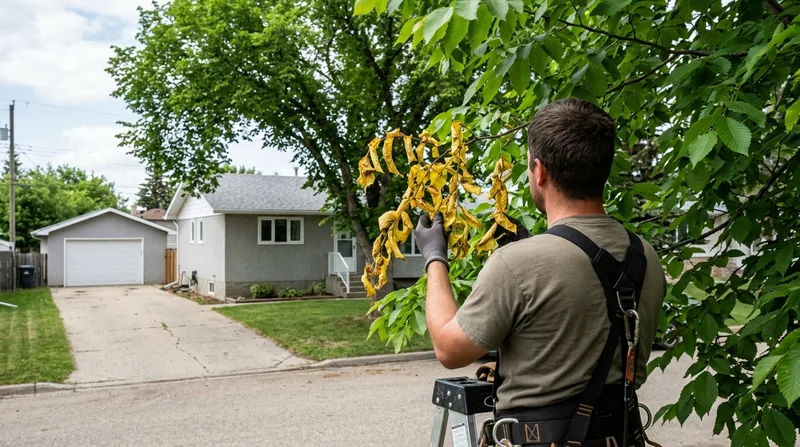




Dutch Elm Disease Management in Regina is a specialized service that protects one of the city's most valued street and landscape trees. American elm dominates many mature neighbourhoods across Regina, and Dutch elm disease (DED) remains a serious threat to these specimens. Our ISA Certified Arborists inspect, diagnose and manage infected or at-risk elms through targeted sanitation pruning, removal planning and reporting to support municipal compliance. Early detection and swift intervention can slow the disease's spread and preserve your tree for years to come. Learn more about our tree disease diagnosis service to understand what we can do for your property.
Why Dutch Elm Disease Management Matters in Regina
Dutch elm disease is a fungal infection spread by elm bark beetles and root grafts between trees. In Regina, where elms line many streets and occupy significant canopy space, a single infected tree can threaten nearby specimens if left unmanaged. The disease causes sudden wilt, branch flagging and dieback, often progressing rapidly once symptoms appear. Provincial regulations require notification and sometimes removal of confirmed cases, making early diagnosis critical. Our arborists recognize the signs that homeowners often miss and recommend the right course of action before neighbours' trees are at risk.
- Inspect elms showing wilt, leaf scorch or one-sided canopy decline for disease confirmation.
- Prune out dead and diseased branches to reduce beetle habitat and slow progression.
- Plan removal of heavily infected trees before they become hazardous or spread spores.
- Document findings in a report that supports your City of Regina permit application if removal is needed.
- Monitor neighbouring elms for early signs so intervention can begin before the disease advances.
Early management of Dutch elm disease protects your investment and reduces the risk of expensive emergency removals later.
Local context: Elm represents roughly 8 to 12 percent of Regina's street tree inventory. A single infected tree in Cathedral or the surrounding neighbourhoods can seed beetles into adjacent properties. Our inspection and sanitation work has helped dozens of Regina homeowners preserve their elms and avoid costly removals.
Our Dutch Elm Disease Management Process
We begin with a thorough on-site inspection to confirm disease presence, assess the tree's structural condition and evaluate the risk to nearby elms. Our ISA Certified Arborists look for vascular discolouration in the sapwood, track beetle entry holes and check for root graft connections to neighbouring trees. Based on findings, we recommend sanitation pruning to remove infected branches, full removal if the tree is beyond recovery, or monitoring if the disease is early-stage. We document everything in a detailed report that you can submit to the City of Regina if a permit is required. Our crews handle all debris removal and can arrange wood chipping for smaller branches.
- Visual and tactile inspection of crown, trunk and root collar for disease symptoms and beetle activity.
- Sapwood sampling or cross-sectioning to confirm vascular discolouration and fungal presence.
- Risk assessment of neighbouring elms and identification of root graft networks in the soil.
- Sanitation pruning of infected limbs, cut back to healthy wood at least 3 metres beyond visible disease.
- Removal and chipping of diseased material to prevent beetle emergence and spore dispersal.
- Written arborist report with photographs, disease stage, treatment options and recommendations for follow-up.
This structured approach ensures that your elm receives the best chance of survival or, if removal is necessary, that the process is managed safely and in compliance with local regulations.
Real example: A Cathedral homeowner noticed yellowing and wilting on one side of a 25-metre elm in late summer. We inspected, confirmed DED in the sapwood, and removed three major infected limbs plus an adjacent smaller elm that showed early symptoms. The main tree recovered and has remained healthy for three seasons. The arborist report supported the homeowner's insurance claim for storm-related follow-up work.
Management Methods and When to Use Them
| Method | Description | When to Use |
|---|---|---|
| Sanitation Pruning | Remove dead and diseased branches back to healthy wood, typically 3 metres beyond visible symptoms. | Early to moderate infection; tree has good structural form and vigour in the remaining crown. |
| Crown Reduction and Thinning | Reduce the overall canopy size to lessen water stress and beetle attractiveness; improve air circulation. | Moderate infection; tree is under environmental stress (drought, compacted soil, nearby construction). |
| Full Removal | Cut the tree to stump and grind the stump to prevent beetle emergence; chip all wood or remove for disposal. | Advanced infection; tree is dying or dead; hazard to structures or power lines; multiple neighbouring elms already affected. |
| Monitoring and Reporting | Annual inspection and documentation of disease progression; arborist report for municipal records or insurance claims. | Suspected early-stage disease; tree is valuable and worth preserving if possible; regulatory compliance required. |
The choice of method depends on the disease stage, the tree's overall health and structure, proximity to utilities or buildings, and your long-term goals for the property. Our arborists will walk you through each option and explain the expected outcome and cost before we begin work.
Regulatory and Safety Considerations in the Regina Area
The City of Regina may require a permit for a private elm removal, and an arborist report supports that application. Rules and thresholds differ from one municipality to the next across the Regina area, so we always advise checking with your local city office before proceeding with removal. Our detailed inspection report documents the disease, photographs the damage and provides a professional recommendation that strengthens your permit request. We also respect approach distances near your private electrical service entrance and never work on the public distribution network of SaskPower. If an elm is touching high-voltage lines, we refer the situation to SaskPower and focus only on clearing your side of the property line. All diseased wood is chipped or removed off-site to prevent beetle emergence in your neighbourhood. Our crews are fully insured and carry liability coverage for all work in Regina and the surrounding municipalities.
For questions about specific permit requirements or timelines in your neighbourhood, call us at (639) 739-5703 or visit our contact page to request a free estimate. We will inspect your elm, confirm the diagnosis and advise you on the next steps, including any municipal notifications or applications needed.
Timing and Seasonal Planning
Dutch elm disease management is best carried out in late fall to late winter, when elms are dormant and beetles are inactive. Pruning during dormancy minimizes stress on the tree and reduces the risk of new beetle colonization. However, if an elm is already showing severe symptoms or poses a safety hazard, we can remove it at any time of year. Spring and early summer inspections are also valuable because beetle activity peaks then and fresh symptoms become visible. If you suspect disease on your property, early diagnosis in spring allows time to plan sanitation or removal before the next dormant season.
Queen City Tree Trimming has been serving Regina since 2016. Our ISA Certified Arborists bring expertise in disease diagnosis and elm management to every job. We also offer complementary services such as tree removal, arborist reports and risk assessment, and tree trimming and pruning to keep your landscape healthy and safe. Contact us today for your free, no-obligation estimate.
Prices Dutch Elm Disease Management in Regina — Indicative pricing
| Service | Price | Details |
|---|---|---|
| Elm Inspection and Diagnosis | From $185 | On-site assessment, disease confirmation, photographs and written findings |
| Sanitation Pruning (small to medium elm) | From $350 | Removal of diseased branches, debris chipping, and site cleanup included |
| Sanitation Pruning (large elm, 20+ metres) | From $650 | Rigging, multiple access points, full debris removal and chipping |
| Full Elm Removal with Stump Grinding | From $1,200 | Tree felling, stump grinding, wood chipping, complete site restoration |
| Arborist Report for Permit Application | From $275 | Detailed written assessment, photographs, disease stage, recommendations for City of Regina submission |
| Free Estimate | No cost | Call (639) 739-5703 or request online for a same-day or next-day inspection |
Indicative prices; free, personalized estimate within 24h at (639) 739-5703.